How E15 Expansion Is Creating New Demand for Grain Movement
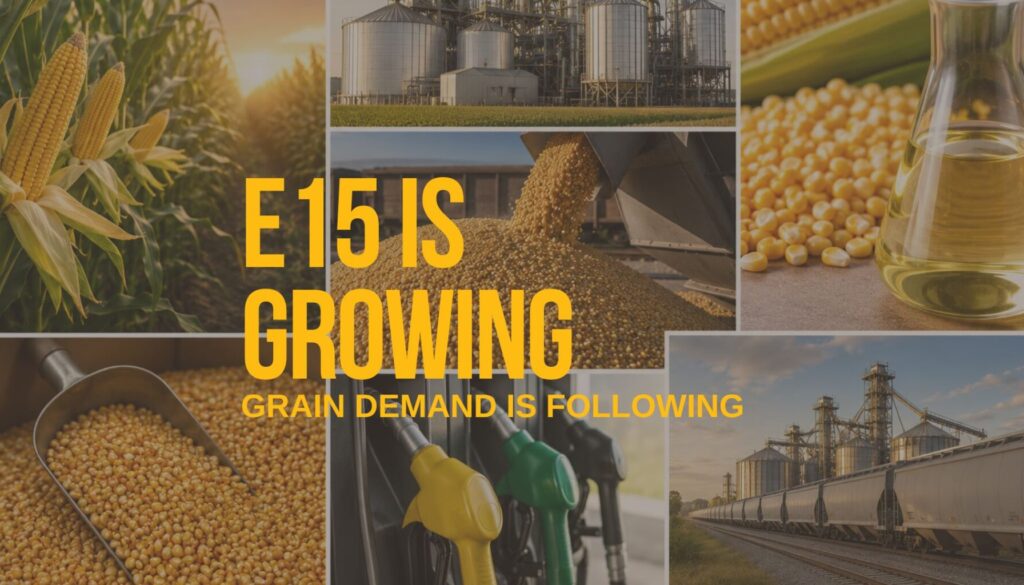
Corn demand doesn’t start and end with exports.
While international markets often dominate agricultural headlines, one of the largest and most consistent drivers of corn demand remains domestic ethanol production. As higher ethanol blends continue gaining traction across the United States, the impact is being felt throughout the agricultural supply chain—from grain elevators and processors to transportation providers and ethanol plants.
For facilities responsible for moving, storing, and loading grain, increased ethanol demand means one thing: more grain movement.
Ethanol Remains a Major Consumer of Corn
Ethanol production continues to account for a significant portion of U.S. corn demand. According to the USDA, approximately 5.5 billion bushels of corn are expected to be used for ethanol production during the current marketing year, making it one of the largest demand categories for the crop.
With roughly one-third of the nation’s corn production ultimately tied to ethanol, the industry provides a stable source of demand that supports grain producers, elevators, processors, and transportation networks throughout the Midwest.
Unlike export demand, which can fluctuate based on global economic conditions and trade policies, ethanol production creates a reliable domestic market that operates year-round.
For many grain-producing regions, ethanol plants serve as major local demand centers that help keep grain moving throughout the supply chain.
Link: USDA projects approximately 5.5 billion bushels of corn for ethanol production
E15 Sales Continue to Reach New Highs
One of the most significant developments in the ethanol industry has been the continued growth of E15.
E15 contains 15% ethanol compared to the 10% ethanol blend commonly found in traditional gasoline. Because most vehicles built since 2001 can use E15, the fuel has become a key focus for ethanol producers and corn growers seeking to expand domestic ethanol demand.
According to the Renewable Fuels Association, nationwide E15 sales increased 23% in 2025, reaching a record 1.52 billion gallons.
While a five-percent increase in ethanol content may sound small, the impact becomes substantial when applied across billions of gallons of fuel consumption each year. As E15 adoption expands, so does the demand for ethanol production—and the corn required to produce it.
Link: Nationwide E15 sales increased 23% in 2025
Why E15 Matters More Than E85
When discussing ethanol, many people immediately think of E85. However, most of the industry’s current growth opportunities are tied to E15.
E85 contains up to 85% ethanol but requires specially equipped flex-fuel vehicles. E15, on the other hand, can be used by the vast majority of modern passenger vehicles already on the road.
That distinction makes E15 significantly more scalable.
Rather than relying on consumers to purchase specialized vehicles, E15 growth can occur through broader fuel availability and increased adoption at retail fueling stations. As a result, many industry experts view E15 as one of the most practical paths toward increasing ethanol consumption in the United States.
More Ethanol Means More Grain Movement
For agricultural facilities, the impact of increased ethanol demand extends far beyond fuel production.
Every additional gallon of ethanol requires corn to move through the supply chain. Grain must be received, stored, processed, loaded, and transported to meet production requirements.
As ethanol plants continue consuming billions of bushels of corn annually, grain elevators and processors must maintain efficient operations to keep product flowing.
That increased activity creates additional demand for:
- Rail transportation
- Truck transportation
- Grain storage
- Loading infrastructure
- Material handling systems
- Railcar switching operations
As demand increases, throughput becomes increasingly important.
Throughput Is Becoming a Competitive Advantage
Many agricultural facilities face a common challenge: demand continues to grow while infrastructure expansion remains costly and time-consuming.
As a result, operators are increasingly focused on maximizing the capacity of existing assets.
Improving railcar positioning, reducing loading delays, optimizing material handling processes, and minimizing operational bottlenecks can help facilities move more grain without adding significant infrastructure.
When transportation costs are elevated and railcar capacity carries a premium, every loading cycle matters.
Facilities that can move grain efficiently are often better positioned to capitalize on strong market demand.
Keeping Grain Moving
The continued growth of E15 represents more than a fuel industry story—it is a grain demand story.
As ethanol producers consume billions of bushels of corn annually and higher ethanol blends continue gaining market share, grain movement throughout the Midwest is expected to remain strong.
For grain elevators, processors, and agricultural facilities, that means continued focus on operational efficiency and throughput.
Control Chief supports agricultural operations with industrial remote-control solutions designed to help operators maximize equipment utilization and improve throughput. Our locomotive remote-control systems help facilities efficiently position railcars during loading and unloading operations, while our industrial remote-control solutions support critical material handling activities throughout the grain supply chain.
As demand for grain movement continues to grow, the ability to move product efficiently remains one of the industry’s most valuable advantages.