What Do the Farm Bill, Regenerative Agriculture and Shaquille O’Neal Have in Common?
At first glance, absolutely nothing.
One is a massive piece of federal agricultural legislation.
One is an approach to farming centered on soil health, water management and long-term productivity.
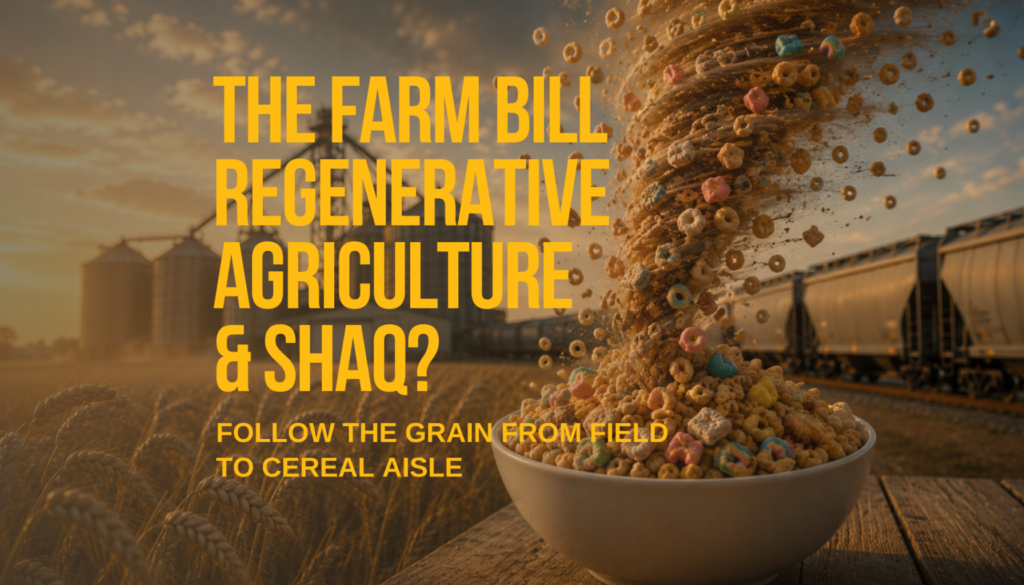
And one is a 7-foot-1 NBA legend who apparently likes to mix multiple cereals together in an enormous bowl to create what he calls a “cereal tornado.”
But follow the grain from the field to the grocery aisle, and suddenly the connections start appearing.
This summer, General Mills, ADM and Walmart announced a new collaboration involving 40,000 acres of Midwest wheat, supporting farmers adopting regenerative agricultural practices in Illinois, Indiana and Missouri.
The wheat comes from regions where General Mills sources grain from ADM for products ultimately sold through Walmart and Sam’s Club.
And those 40,000 acres are only one piece of a much bigger effort.
General Mills and Walmart previously committed to advancing regenerative agriculture across 600,000 acres by 2030 — approximately the number of acres General Mills engages to source key ingredients for products sold through Walmart and Sam’s Club.
According to General Mills, programs are now underway across more than 560,000 U.S. wheat acres.
Meanwhile, General Mills is chasing another enormous change in the American food market:
Protein.
The company has been introducing higher-protein versions of familiar foods as consumers increasingly look for protein throughout the day.
That includes cereal.
General Mills partnered with sports-nutrition company GHOST to launch protein versions of Cinnamon Toast Crunch and Lucky Charms, each containing 17 grams of protein per serving.
And who is currently helping General Mills promote cereal?
Shaquille O’Neal.
General Mills recently recruited Shaq to help find “America’s Biggest Cereal Fans,” promoting brands including Cinnamon Toast Crunch, Lucky Charms, Reese’s Puffs and Honey Nut Cheerios.
So yes:
The Farm Bill, regenerative agriculture, Walmart, protein cereal and Shaquille O’Neal really do belong in the same story.
Because behind the celebrity endorsements and brightly colored cereal boxes is an agricultural supply chain undergoing some significant changes.
And it starts in the field.
Let’s Start With 40,000 Acres of Wheat
On July 15, 2026, General Mills, ADM and Walmart announced a strategic collaboration designed to accelerate regenerative agriculture across 40,000 acres of Midwest wheat.
The project focuses on Illinois, Indiana and Missouri.
That’s significant because those are growing regions where General Mills sources wheat from ADM for products sold through Walmart and Sam’s Club.
The companies say participating farmers will receive support for adopting practices intended to improve:
- Soil health
- Water quality
- Carbon sequestration
- Long-term farm resilience
Technical assistance for the initial projects will come from the American Farmland Trust and Ducks Unlimited.
ADM brings considerable scale to the project.
According to the announcement, ADM already manages nearly 5 million regenerative acres globally.
General Mills and Walmart bring another enormous commitment.
Back in 2023, General Mills, Walmart and Sam’s Club announced a goal of advancing regenerative agriculture across 600,000 U.S. acres by 2030.
That number wasn’t chosen randomly.
According to the companies, 600,000 acres represents approximately the amount of land General Mills engages to source key ingredients for products it sells through Walmart and Sam’s Club.
Three years later, General Mills says programs are already underway across more than 560,000 wheat acres in the United States.
This isn’t a small experimental plot anymore.
It’s beginning to operate at supply-chain scale.
What Is Regenerative Agriculture?
Here’s where things get slightly complicated.
There isn’t one universally accepted recipe for “regenerative agriculture.”
It isn’t a certification like organic farming where a single federal standard determines whether a farm qualifies.
Instead, regenerative agriculture generally refers to a collection of farming and conservation practices intended to improve the health and long-term productivity of the land.
The USDA Natural Resources Conservation Service defines regenerative agriculture as:
“A conservation management approach that emphasizes natural resources through improved soil health, water management, and natural vitality.”
In practical terms, regenerative farming can involve combinations of practices such as:
- Cover crops
- Crop rotation
- Reduced tillage or no-till farming
- Nutrient management
- Integrated pest management
- Improved grazing management
- Residue management
- Water-management practices
- Maintaining living roots for longer portions of the year
- Increasing crop diversity
The exact combination depends on the farm.
A wheat operation in Indiana isn’t necessarily going to use the same practices as a cattle operation in Nebraska or a cotton farm in Texas.
And that’s an important distinction.
Regenerative agriculture isn’t one practice. It’s an approach.
The idea is to look at the farm as an interconnected system rather than treating soil fertility, erosion, water, pests and crop production as completely separate problems.
Why Soil Health Matters
Healthy soil isn’t just dirt that holds a plant upright.
It’s an extraordinarily complicated biological system containing minerals, organic matter, microorganisms, fungi, insects, roots, water and air.
How farmers manage that system can affect how well soil absorbs rainfall, holds nutrients, resists erosion and supports crops during stressful conditions.
Consider cover crops.
Instead of leaving a field bare after harvest, a farmer may plant rye, clover, radishes or another cover crop.
Those plants can help protect soil from erosion.
Their roots can help maintain soil structure.
Some cover crops can capture nutrients that might otherwise leave the field.
Legumes can add biologically fixed nitrogen.
And additional plant material can contribute organic matter back to the soil.
Reduced tillage works differently.
Rather than aggressively disturbing the soil every year, farmers can reduce tillage or use no-till systems.
That can reduce erosion and preserve soil structure.
Crop rotation adds another layer by changing which crops — and therefore which root systems, nutrient demands, diseases and pests — occupy the field from year to year.
None of these practices is new.
Farmers have used variations of them for generations.
What’s changing is the amount of attention — and money — now flowing toward combining them under the banner of regenerative agriculture.
Washington Is Getting Involved
And this is where our story starts connecting to the Farm Bill and federal agricultural policy.
In December 2025, USDA announced a new $700 million Regenerative Pilot Program.
The funding includes:
$400 million through the Environmental Quality Incentives Program, or EQIP
and
$300 million through the Conservation Stewardship Program, or CSP.
Those aren’t obscure programs.
EQIP and CSP are two of USDA’s major conservation programs, providing technical and financial assistance to farmers implementing conservation practices.
The new regenerative pilot takes a more whole-farm approach.
Instead of looking only at individual conservation practices, USDA says participating farmers can develop a regenerative agriculture conservation plan addressing resource concerns across their entire operation.
USDA says the goal is to improve soil health, enhance water quality, lower production costs and improve long-term agricultural productivity.
And there’s another important detail.
The agency explicitly connected the program to the federal government’s Make America Healthy Again — MAHA — agenda.
Where Does MAHA Fit Into Agriculture?
MAHA is usually discussed as a public-health initiative.
But food doesn’t begin in a grocery store.
It begins in agriculture.
That has pulled farming practices, food processing, pesticides, soil health and nutrition into the same national conversation.
When USDA announced the $700 million regenerative pilot, Agriculture Secretary Brooke Rollins was joined by Health and Human Services Secretary Robert F. Kennedy Jr. and CMS Administrator Dr. Mehmet Oz.
USDA said the program was building on the administration’s Make Our Children Healthy Again Strategy.
HHS also announced plans to invest in research examining potential connections between regenerative agriculture and public health.
Then, in June 2026, the administration went further.
President Trump signed an executive order advancing regenerative agriculture, while USDA announced a new Regenerative Feedstock Rule intended to create additional value for farmers using qualifying regenerative practices in biofuel supply chains.
In other words, regenerative agriculture is no longer just something being discussed by conservation organizations and food companies.
It has become part of federal agricultural policy.
And Yes, This Is Where Glyphosate Enters the Conversation
This connection needs some nuance.
Glyphosate — the active ingredient best known through products such as Roundup — has become one of the most controversial agricultural chemicals in the United States.
It is also enormously important to modern crop production.
Glyphosate is used to control weeds across millions of acres of American farmland and has played a particularly significant role in no-till and reduced-tillage systems.
That’s where the regenerative agriculture discussion becomes complicated.
Reducing tillage can be beneficial for soil structure and erosion.
But if a farmer doesn’t mechanically till a field to control weeds, those weeds still have to be controlled somehow.
Herbicides can provide that control.
That means practices promoted as part of regenerative agriculture — particularly no-till farming — can sometimes increase a farmer’s reliance on chemical weed control rather than eliminate it.
So regenerative does not automatically mean pesticide-free.
And regenerative does not mean organic.
That’s an important distinction.
MAHA Has Also Put Pesticides Under the Microscope
The MAHA movement has brought increased public attention to pesticides and chemical exposure.
An earlier MAHA report specifically raised questions involving agricultural chemicals, including glyphosate.
That immediately created concern throughout farm country.
Grower organizations argued that restricting commonly used crop-protection products without practical alternatives could increase production costs, reduce yields and potentially force farmers back toward more intensive tillage.
The final MAHA strategy released in September 2025, however, took a more measured approach.
It did not call for banning glyphosate.
Instead, the administration emphasized research, transparency, EPA’s pesticide-review process, agricultural innovation and collaboration with farmers.
That leaves an interesting tension at the center of the regenerative agriculture conversation.
On one side:
Reduce chemical exposure. Improve soil health. Rethink how food is produced.
On the other:
Farmers still have to control weeds, insects and disease while producing enough food to remain economically viable.
Those goals aren’t always easy to reconcile.
Could Regenerative Agriculture Reduce Chemical Use?
Potentially.
But the answer isn’t as simple as replacing a jug of herbicide with a cover crop.
A more diverse crop rotation can interrupt weed and pest cycles.
Cover crops can compete with weeds.
Improved soil health can potentially improve crop resilience.
Integrated pest management encourages producers to use multiple tools rather than relying automatically on one control method.
But those practices don’t necessarily eliminate pesticides.
And sometimes conservation practices can create tradeoffs.
A farmer using conventional tillage may control weeds mechanically but disturb more soil.
A no-till farmer may dramatically reduce soil disturbance but depend more heavily on herbicides.
A cover crop may suppress weeds but also has to be terminated before the next crop is established.
Depending on the crop, geography and farming system, that termination might involve herbicides.
Agriculture rarely offers perfectly simple choices.
That’s why the federal government’s current approach is notable.
Rather than defining regenerative agriculture as pesticide-free agriculture, USDA’s program actually includes Pest Management Conservation Systems among practices that can be incorporated into a regenerative conservation plan.
That’s a much more realistic reflection of how commercial agriculture works.
So Where Does the Farm Bill Come In?
Many of the programs supporting conservation on American farms ultimately connect back to the Farm Bill.
Programs such as EQIP and CSP are major components of federal conservation policy.
The Senate’s current Farm Bill 2.0 proposal includes provisions intended to modernize conservation programs and give producers additional tools for managing their operations.
That makes the Farm Bill much more than a commodity-support discussion.
It’s also part of the framework determining how federal conservation dollars reach farmers.
What practices qualify?
How much funding is available?
How difficult is it to participate?
How are results measured?
And perhaps most importantly:
Can conservation practices make economic sense for the farmer actually implementing them?
Because no agricultural practice scales very far if the farmer can’t afford to use it.
Private Companies Are Trying to Answer That Question Too
This is what makes the General Mills-ADM-Walmart project particularly interesting.
Government isn’t the only source of money moving toward regenerative agriculture.
The private supply chain is getting involved.
General Mills needs ingredients.
ADM sources and processes agricultural commodities.
Walmart and Sam’s Club need products to put on shelves.
And all three companies depend on farmers.
Instead of each company treating regenerative agriculture as someone else’s responsibility, they’re attempting to work across the supply chain.
The 40,000-acre Midwest wheat project is designed around the regions where General Mills already sources wheat from ADM for products sold through Walmart and Sam’s Club.
That’s important.
These aren’t hypothetical acres.
They’re connected to an existing commercial supply chain.
Farmer → ADM → General Mills → Walmart/Sam’s Club → Consumer.
And every participant has a reason to care about what happens upstream.
The farmer cares about productivity and profitability.
ADM cares about reliable grain supplies.
General Mills cares about ingredient availability.
Walmart cares about products and supply-chain resilience.
Consumers care about price, nutrition and increasingly how their food is produced.
Different motivations.
Same wheat.
Then Comes the Protein Boom
While the agricultural side of the food system is changing, consumer demand is changing too.
One of the clearest examples is protein.
Walk through almost any grocery store and the word is everywhere.
Protein shakes.
Protein bars.
Protein yogurt.
Protein pancakes.
Protein snacks.
Protein cereal.
General Mills has been aggressively responding to that demand.
The company says its protein portfolio has expanded across multiple brands, including Cheerios Protein, Nature Valley Protein, Ratio Protein and collaborations with sports-nutrition company GHOST.
Its GHOST protein cereals take two extremely familiar General Mills brands and give them a sports-nutrition makeover:
Cinnamon Toast Crunch.
Lucky Charms.
According to General Mills, the products contain 17 grams or more of protein per serving.
That’s a very different cereal proposition from the one consumers grew up with.
But it’s a perfect example of how food companies respond to changing consumer preferences.
The grain isn’t simply being grown.
It’s being turned into products designed around what consumers currently want.
And Finally, We Arrive at Shaq
Which brings us back to Shaquille O’Neal.
In August, General Mills announced that Shaq would help the company search for “America’s Biggest Cereal Fans”.
The campaign centers on some of General Mills’ most recognizable cereal brands:
- Cinnamon Toast Crunch
- Lucky Charms
- Reese’s Puffs
- Honey Nut Cheerios
Shaq isn’t exactly pretending to like cereal for the commercial.
He apparently really likes cereal.
In an interview with People, O’Neal described Lucky Charms as a childhood favorite he still eats and explained his preferred approach to cereal consumption.
It involves combining several cereals in a very large bowl.
He calls it his “tornado mix.”
It’s funny.
It’s marketable.
It’s also the very last link in a remarkably long chain.
Follow the Grain Backward
Look at the cereal box on the grocery-store shelf.
Behind it is a celebrity helping market the brand.
Behind the celebrity is General Mills.
Behind General Mills are retailers like Walmart and Sam’s Club.
Behind the food manufacturer is a grain company like ADM.
Behind ADM are farmers.
Behind those farmers are decisions involving seed, fertilizer, herbicides, crop rotation, tillage, cover crops, weather, soil, machinery and economics.
And increasingly behind some of those decisions are federal policies and conservation programs.
Suddenly:
Shaq → General Mills → Walmart → ADM → Wheat Farmer → Regenerative Agriculture → USDA → MAHA → Farm Bill
doesn’t seem nearly as strange.
It’s one supply chain.
Regenerative Agriculture Is Becoming an Economic Question
There has been plenty of debate about what regenerative agriculture should mean.
That debate will continue.
But something more practical is now happening.
Money is moving.
USDA has committed $700 million through its regenerative pilot.
General Mills and Walmart are targeting 600,000 acres by 2030.
Programs are already underway across more than 560,000 U.S. wheat acres.
General Mills, ADM and Walmart have added a focused 40,000-acre Midwest wheat initiative.
ADM says it manages nearly 5 million regenerative acres globally.
Those numbers suggest regenerative agriculture is moving beyond conference panels and sustainability reports.
Farmers are being asked to implement it.
Companies are investing in it.
Government programs are funding it.
Processors are incorporating it into supply chains.
Retailers are attaching purchasing strategies to it.
And eventually the grain grown on those farms becomes something consumers recognize.
Flour.
Bread.
Snacks.
Cereal.
The Bigger Picture
The most interesting part of this story isn’t Shaquille O’Neal.
It isn’t even cereal.
It’s how many different parts of American agriculture are becoming connected.
Health policy is reaching into agriculture.
Agricultural policy is reaching into soil management.
Food companies are reaching further upstream into farming practices.
Retailers are working with manufacturers and processors on how ingredients are produced.
Consumers are changing what food companies manufacture through their demand for things like protein.
And farmers are sitting at the beginning of all of it.
They’re still responsible for the part that makes everything else possible:
Growing the crop.
The next time you see Shaquille O’Neal holding a bowl of Lucky Charms, there may be considerably more behind that cereal box than marshmallows and marketing.
Somewhere upstream is a food company deciding what consumers want.
A retailer deciding what it wants on its shelves.
A grain company building a supply chain.
A farmer deciding what to plant and how to grow it.
And increasingly, government agricultural policy influencing which practices are encouraged and how farmers are compensated for adopting them.
From the Farm Bill to the farm field to the cereal aisle, it’s all part of the same agricultural supply chain.
Control Chief: Helping Keep the Grain Supply Chain Moving
From the wheat field to the cereal aisle, there are a lot of steps in between.
Grain has to be harvested, stored, transferred, processed, loaded and transported — often moving through multiple facilities before it ever becomes a finished product.
For more than 55 years, Control Chief has helped keep that supply chain moving with industrial wireless remote control solutions built for demanding material-handling environments.
Locomotive Remote Control for Grain Operations
Rail remains a critical part of the grain supply chain. Grain elevators, processing facilities, ethanol plants, mills and terminals rely on locomotives to position railcars for loading and unloading.
Control Chief’s Locomotive Remote Control Systems put locomotive movement in the hands of trained ground operators, allowing them to control railcar positioning while maintaining a better view of the operation.
That can mean greater flexibility when spotting cars, building cuts and keeping grain moving through a facility.
Wireless Remote Control for Shiploaders
At export terminals, the journey continues.
Control Chief also provides wireless remote control solutions for shiploading equipment, allowing operators to control critical equipment without being tied to a fixed operator station.
For operations handling thousands — or millions — of bushels, giving operators the ability to control equipment from a better vantage point can make a meaningful difference in how efficiently material moves.
A lot has changed in agriculture over the past 55 years.
The crops have changed. The technology has changed. The markets have changed. And, as regenerative agriculture demonstrates, even the way we think about growing grain continues to evolve.
But one challenge remains remarkably consistent:
Once you grow it, you have to move it.
Control Chief helps grain operations do exactly that.
Learn more about Control Chief’s wireless remote control solutions →