New Wisconsin Soybean Plant Will Put More Agricultural Products—and More Pressure—on the Rails
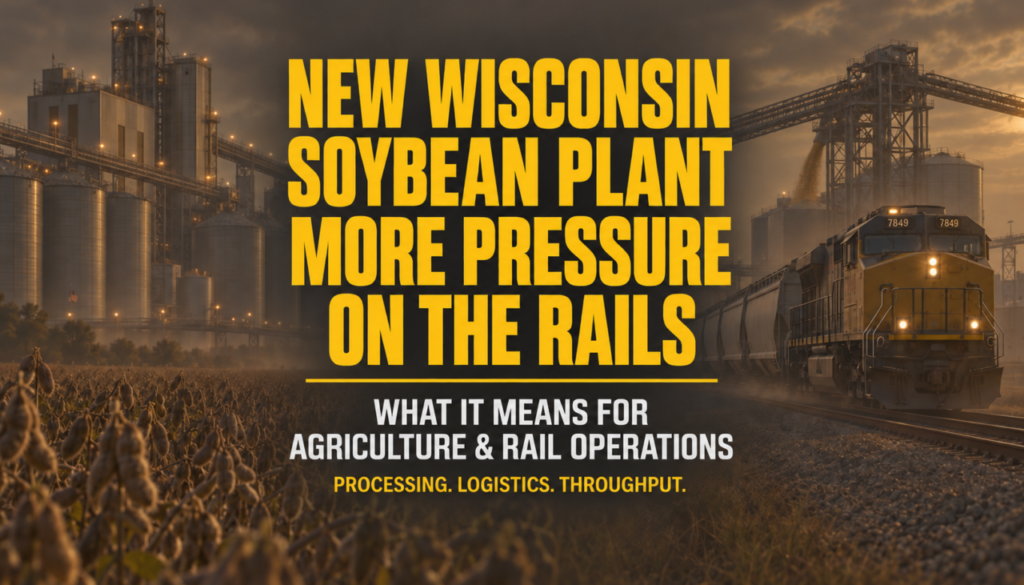
The U.S. soybean market is adding domestic processing capacity—and every new plant changes more than the crush numbers. It creates a new destination for farmers, a new source of meal and oil for customers, and a new set of demands on the transportation network that connects them.
CHS’s newly announced project near Evansville, Wisconsin, is a timely example of that larger push.
Announced on September 14, 2026, the approximately $700 million facility is designed to process 80 million bushels of U.S.-grown soybeans annually. CHS expects it to produce about 1 billion pounds of soybean oil and 2 million tons of soybean meal each year, employ approximately 80 people and support hundreds of construction and skilled-trade positions. Construction is expected to begin in the coming weeks, with completion targeted for fall 2028.
For CHS, Evansville will complement existing soybean operations in Fairmont and Mankato, Minnesota, and increase the cooperative’s soybean processing capacity by more than two-thirds. For the market, it is another signal that processors are positioning closer to soybean production, livestock demand and the transportation infrastructure needed to serve both.
Location is central to the strategy. Southern Wisconsin combines a strong soybean-growing region with livestock customers that consume soybean meal, plus rail service and major transportation corridors. That gives the facility access to both sides of the processing equation: soybeans moving in and finished oil and meal moving out.
The proposed scale shows why projects like this matter beyond a single company. USDA data show that Wisconsin farmers harvested approximately 113.1 million bushels of soybeans in 2025. The Evansville plant’s stated annual capacity is equal to roughly 71% of that total. That does not mean the facility will source only Wisconsin-grown soybeans, but it illustrates the pull a new demand center of this size could exert across the region.
For farmers, added processing can mean another market closer to where soybeans are grown. For livestock producers, it can mean more direct access to locally produced soybean meal. A 2023 Wisconsin Soybean Marketing Board feasibility study had already identified a need for in-state crush capacity, noting that Wisconsin produced more than 100 million bushels annually but had limited in-state delivery options. The study estimated that a nearby crushing facility could improve local soybean basis by 12 to 15 cents per bushel, although actual basis effects will depend on supply, competition, freight and market conditions.
CHS is one example, but the underlying story is nationwide: more soybeans are being processed domestically, and the agricultural supply chain must move more volume through increasingly complex networks.
What is driving the soybean processing push?
More value is being created through domestic processing, supported by demand for both major products that come out of the crush.
Demand for soybean oil extends across food manufacturing and renewable fuels, while soybean meal remains a foundational protein ingredient for dairy, poultry, swine and other livestock markets. According to USDA’s 2025 oilseed crush summary, U.S. processors crushed 75.2 million tons of soybeans for crude oil—7% more than in 2024—and produced 29.5 billion pounds of crude soybean oil, also up 7%.
Federal fuel policy is reinforcing the oil side of that equation. EPA’s final Renewable Fuel Standard volumes for 2026 and 2027 set total biomass-based diesel requirements, including reallocated volumes, at 9.07 billion and 9.20 billion RINs respectively. Soybean oil competes with other feedstocks in that market, but the policy contributes to the long-term demand signal supporting domestic oilseed processing.
At the same time, the United States is producing a large soybean crop. USDA’s September 2026 market estimates put the crop at approximately 4.535 billion bushels, with projected 2026–27 ending stocks of 310 million bushels. In that environment, strategically located processing capacity can create additional domestic demand while connecting growers to food, feed, fuel and export markets.
But additional capacity also redraws the logistics map.
Elevators and processors may compete for the same bushels. Origination territories can shift. Truck routes and delivery windows can change. Railroads must position equipment, locomotives and crews around seasonal volumes. Plants must keep raw materials moving in while shipping meal and oil out—without allowing congestion in the yard or delays at load-out to constrain production.
Rail is central to making that system work at scale. The Association of American Railroads reports that railroads move about 1.6 million carloads of grain and 764,000 carloads of grain-related products—including soybean oil and soybean meal—each year. Rail handles approximately 24% of domestic grain movements and 39% of grain export movements.
For large soybean processing facilities, rail access is not merely a site-selection advantage. It is part of the production system.
The rail challenge inside a soybean processing facility
Mainline transportation receives much of the attention, but performance inside the plant matters too.
Railcars must be spotted accurately for loading or unloading. Cars must be advanced through load-out at the right pace. Loaded cars must be assembled and moved so they are ready for railroad pickup. Those movements must be coordinated around people, equipment, production schedules and tight operating areas.
When internal rail movement is slow or inconsistent, the effects can spread through the operation:
- Load-out takes longer than planned.
- Railcars occupy tracks and loading positions unnecessarily.
- Employees rely on additional radio calls, hand signals or cab-to-ground coordination.
- Production and shipping schedules become harder to synchronize.
- Poor visibility at coupling or spotting points can add risk.
As soybean processing expands, these are not minor yard issues. They are throughput issues.
Where locomotive remote control fits
Locomotive remote control allows a trained operator on the ground to control locomotive movement from a position with a clearer view of the railcars, track and loading area, rather than relying exclusively on control from inside the locomotive cab.
That capability can help agricultural facilities address three persistent operating needs.
Better visibility for precise car positioning. An operator can work from an appropriate ground position and see the movement being performed. This is especially useful when spotting cars at receiving pits, load-out points or other fixed locations where accuracy matters.
More direct control of switching and load-out movements. Reducing layers of cab-to-ground communication can help simplify repetitive industrial rail moves and keep rail activity aligned with the plant’s workflow.
Technology configured for the operation. Industrial facilities differ in their locomotives, track arrangements, loading processes and operating environments. The right remote control configuration must fit the work being performed.
Remote control does not replace disciplined operating procedures, training or compliance. It gives qualified operators a tool designed to improve their control and vantage point during industrial rail movements.
That is increasingly important as the soybean supply chain adds processing capacity. Investments such as the CHS Evansville facility are intended to create more value from every bushel. Capturing that value requires more than crushing equipment and storage. It requires the reliable movement of railcars through the facility, shift after shift, shipment after shipment.
About Control Chief
Control Chief has designed and manufactured industrial remote control solutions since 1971. Our locomotive systems serve demanding operations in agriculture, aggregate, steel, mining, power generation and other industries where safe, precise and efficient railcar movement matters.
Control Chief offers a complete range of locomotive remote control options for industrial rail operations:
- MU&Go®plus+™ is a transportable locomotive remote control solution for facilities that need flexibility across compatible locomotives or do not want a permanent installation. It incorporates Control Chief’s Safety Triad technology and proven locomotive-control engineering.
- TrainChief®plus+™ is permanently installed in the locomotive cab and can be customized for the locomotive equipment set and application. Available options include speed control, speed limiting, headlight control, man-down remote notification and engine protection.
- Load-Out Management System gives a control-room operator real-time position control of the locomotive during loading and production cycles. Designed for grain, aggregate and coal applications, it can be configured for site-specific equipment and workflows, provides operational information through an HMI, and uses logic-based permissive and inhibit safeguards. It can work with either MU&Go®plus+™ or TrainChief®plus+™.
From transportable control to permanent installation and integrated load-out management, Control Chief works with each customer to match the system to the locomotive, facility and operating process.
The soybean market is building for more domestic processing. The facilities that serve it need rail operations built to keep pace.
Explore all Control Chief locomotive remote control solutions or contact our locomotive specialists to discuss your agricultural rail application.