How Long Should an Industrial Remote Control Last? 9 Signs It May Be Time for an Upgrade
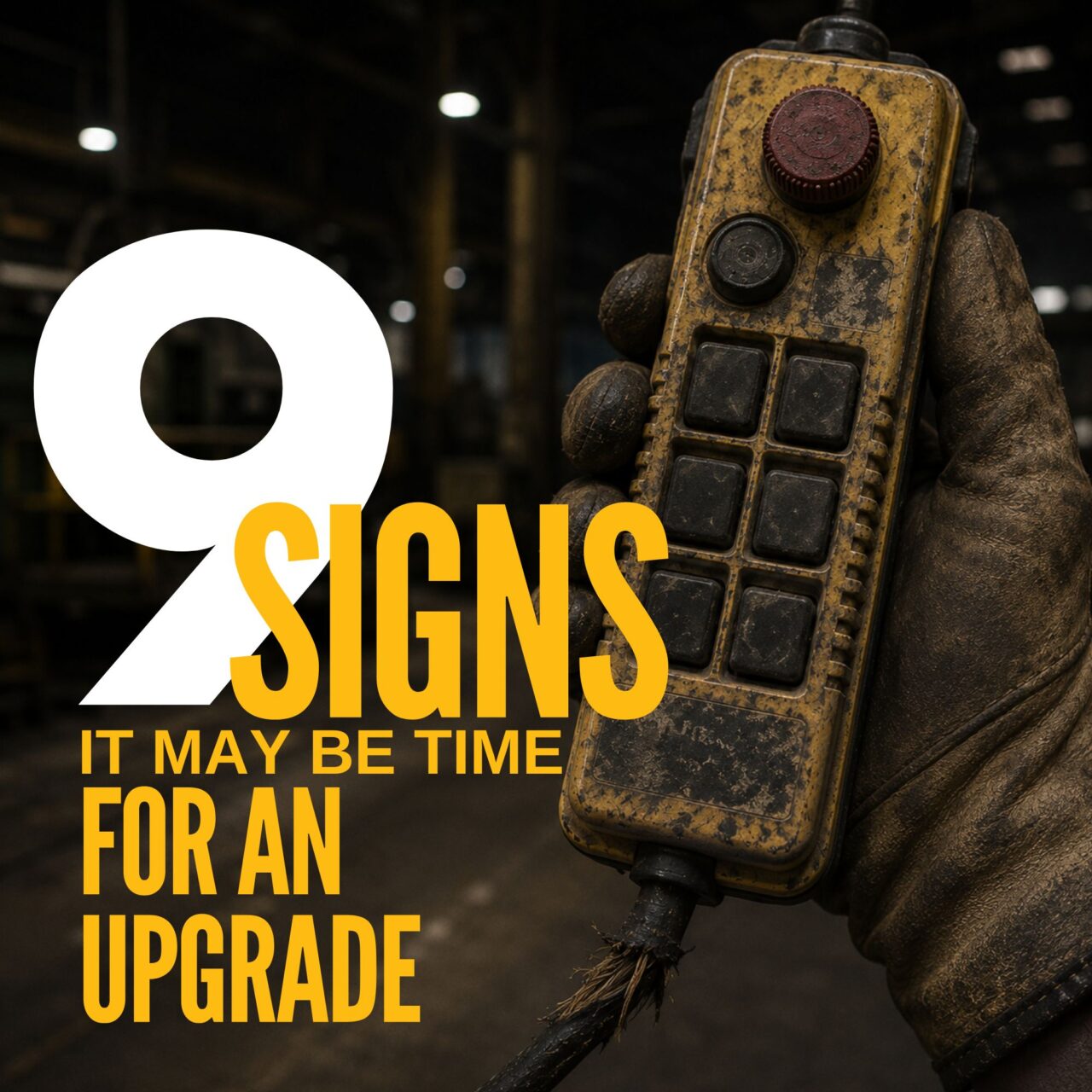
Industrial remote controls are built to last.
They’re designed to operate in demanding environments where dust, vibration, moisture, heat, cold, and daily wear are simply part of the job. Whether they’re controlling an overhead crane, conveyor system, hoist, or other industrial equipment, a dependable wireless remote becomes an essential part of day-to-day operations.
But no industrial equipment lasts forever.
Unlike a motor that suddenly fails or a gearbox that begins making noise, remote control systems often show signs of aging gradually. Operators adapt. Maintenance teams make repairs. Production continues.
Until one day, the system isn’t just old—it has become a liability.
Knowing when to evaluate your existing remote control system before it reaches that point can help reduce downtime, improve productivity, and avoid costly disruptions.
Here are nine signs it may be time to consider an upgrade.
1. Reliability Has Become Unpredictable
The biggest warning sign often isn’t complete failure.
It’s inconsistency.
If your remote works perfectly one day but becomes unreliable the next, operators begin losing confidence in the equipment. Intermittent problems can also be frustrating for maintenance personnel because they don’t always appear during testing.
Reliable equipment should inspire confidence—not uncertainty.
2. Operators Have Developed Workarounds
Experienced operators are incredibly adaptable.
They know which button requires extra pressure.
They know where to stand for the best signal.
They know the “trick” that gets everything working again.
Those workarounds may keep production moving, but they also indicate the control system isn’t performing the way it should.
When operators are adapting to the equipment instead of the equipment supporting the operator, it’s worth taking a closer look.
3. Small Interruptions Are Adding Up
A five-minute delay doesn’t seem significant.
Neither does stopping to troubleshoot a transmitter, replacing batteries unexpectedly, or resetting equipment.
But those interruptions rarely happen only once.
Over weeks and months, those lost minutes become lost production.
As manufacturers continue looking for ways to improve efficiency, reducing unnecessary interruptions can have a measurable impact.
4. Maintenance Is Spending More Time on the Same System
Every industrial facility expects maintenance.
The concern isn’t maintenance itself.
It’s when the same remote control system repeatedly requires attention.
Repeated troubleshooting, recurring repairs, or spending valuable maintenance hours keeping an aging system operational all have costs that often aren’t reflected on a purchase order.
Sometimes the most expensive equipment isn’t the one that fails.
It’s the one that constantly demands attention.
5. Replacement Parts Are Becoming More Difficult to Find
Many industrial facilities continue operating equipment for decades.
That’s a testament to good maintenance practices.
However, older control systems may eventually present new challenges as replacement components become more difficult to obtain.
Long lead times, discontinued parts, or limited availability can turn what should have been a routine repair into an extended production delay.
Planning ahead before parts become an issue is often the better strategy.
6. Your Operation Has Changed
Very few facilities operate today exactly as they did ten or twenty years ago.
Production has increased.
Equipment has been relocated.
Workflows have evolved.
Labor shortages have changed how facilities operate.
What was once an effective control system may no longer provide the flexibility operators need today.
Modern wireless remote controls allow operators to work where they have the best visibility of the equipment and surrounding work area, improving both efficiency and operational awareness.
Choosing the Right Handheld Remote Control
If you’ve determined it’s time to evaluate your current system, the next question becomes which type of remote control is right for your application?
Not every industrial environment has the same requirements.
Some applications benefit from compact handheld transmitters that are easy to carry throughout the workday, while others require additional buttons, more complex control layouts, or customized configurations.
At Control Chief, our handheld industrial remote control solutions are designed to support a wide variety of applications, including:
- Overhead cranes
- Hoists
- Conveyor systems
- Material handling equipment
- Manufacturing machinery
- Industrial automation
- Specialty equipment
Whether your goal is improving operator mobility, increasing visibility, simplifying operation, or modernizing older equipment through a retrofit, selecting the right wireless control system starts with understanding the application—not simply choosing a transmitter.
Because every operation is different, our team works with customers to recommend the handheld remote control solution that best fits their equipment, environment, and operational goals.
👉 Explore our Handheld Industrial Remote Controls to see solutions designed for industrial applications.
7. Operator Visibility Has Become More Important
One of the greatest advantages of wireless control isn’t convenience.
It’s visibility.
Instead of being limited by a pendant cable or fixed control station, operators can often position themselves where they have the clearest view of the load, machinery, or surrounding work area.
Better visibility can improve productivity while also helping operators make more informed decisions throughout each operation.
8. Productivity Expectations Continue to Increase
Today’s facilities are expected to accomplish more with fewer people.
That means every improvement matters.
While upgrading a remote control system won’t solve every operational challenge, improving the way operators interact with equipment can eliminate unnecessary movement, improve workflow, and help reduce small inefficiencies that accumulate throughout the day.
9. You’re Already Planning Equipment Upgrades
One of the best opportunities to evaluate an industrial remote control system is during other planned maintenance or modernization projects.
If electricians are already scheduled, production lines are being upgraded, or equipment will already be offline, it’s an ideal time to determine whether your existing control system still supports your operational goals.
Addressing multiple improvements during one planned shutdown is often more efficient than waiting for another unexpected failure.
Upgrading Doesn’t Always Mean Replacing Your Equipment
One common misconception is that upgrading an industrial remote control system requires replacing the equipment itself.
In many cases, that’s simply not true.
Modern wireless control systems can often be integrated into existing machinery, allowing facilities to improve the way equipment is operated without replacing assets that still have years of productive life remaining.
For many operations, retrofitting a wireless control system offers an opportunity to improve productivity, operator mobility, and overall efficiency while maximizing the value of existing equipment.
The Bottom Line
Industrial remote controls are built to withstand demanding environments—but like any piece of industrial equipment, there comes a point when evaluating an upgrade simply makes good operational sense.
If you’ve noticed increasing maintenance, recurring reliability issues, changing operational requirements, or opportunities to improve productivity, now may be the right time to take a closer look at your existing control system.
At Control Chief, we’ve helped industrial facilities modernize the way they operate equipment for decades. Our handheld industrial remote control solutions are engineered for reliability, flexibility, and the demanding environments found in manufacturing, material handling, overhead lifting, and countless other industrial applications.
Whether you’re considering a retrofit, replacing an aging control system, or planning a future equipment upgrade, we’re here to help you identify the right solution for your application.
Ready to modernize your operation? Explore our Handheld Industrial Remote Controls or contact Control Chief to discuss your application with one of our industrial control specialists.