U. S. Steel’s $350 Million Gary Works Restart Highlights New Investment in American Steel Manufacturing
From Indiana to Pennsylvania and across the country, major steelmaking investments are strengthening domestic production and modernizing the operations that keep American industry moving.
American steel manufacturing is seeing a renewed wave of investment as producers upgrade existing facilities, expand production capabilities, and strengthen domestic supply chains.
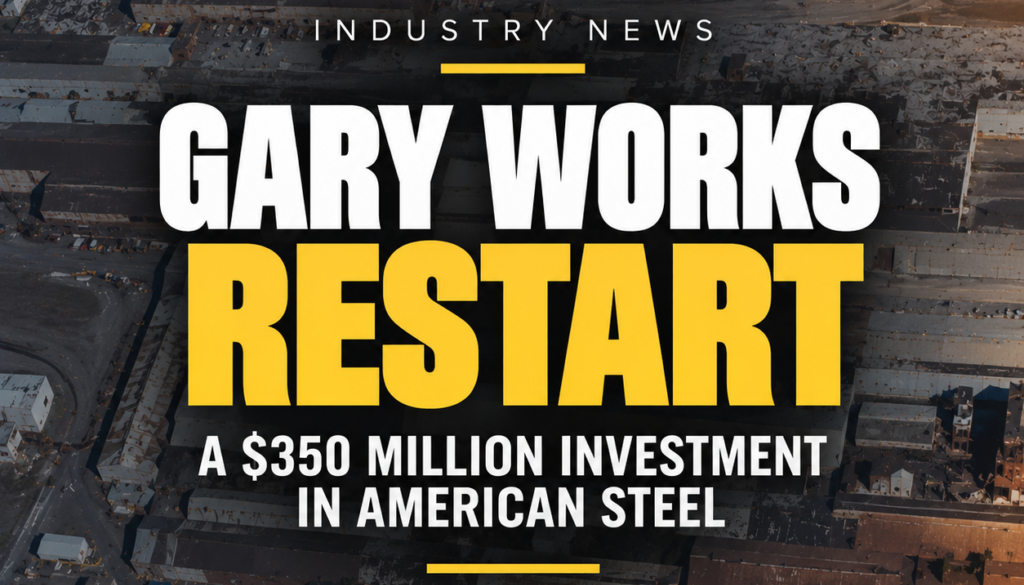
One of the latest milestones comes from U. S. Steel’s Gary Works in Gary, Indiana, where the company has returned its largest blast furnace to service following a $350 million refurbishment.
The project is one of several major steel industry investments announced or completed in 2026, reflecting a broader commitment to modernizing American steelmaking infrastructure.
Gary Works Returns Its Largest Blast Furnace to Service
On September 3, 2026, U. S. Steel announced the successful restart of Blast Furnace No. 14 at Gary Works following an extensive $350 million reline and maintenance project.
The furnace, the largest in U. S. Steel’s operating footprint, is capable of producing more than 2 million tons of hot metal annually.
The project involved replacing the furnace’s refractory lining, restoring critical operating systems, and performing extensive maintenance on supporting infrastructure. More than one million labor hours went into the effort, with approximately 1,000 contractors working on-site during peak activity.
The investment is expected to extend the furnace’s productive life and support continued steel production for years to come.
The furnace also represents an important connection within the domestic steel supply chain. Iron ore pellets produced at U. S. Steel’s Minnesota Ore Operations supply the facility, linking American mining operations directly to steel production in Indiana.
Sources: U. S. Steel — Gary Works Blast Furnace No. 14 Restart | Association for Iron & Steel Technology — $350 Million Gary Works Reline
A Broader Wave of Investment Across American Steel
The Gary Works restart is part of a larger series of investments taking place throughout U. S. Steel’s domestic operations.
In Illinois, U. S. Steel restarted Blast Furnace B at Granite City Works in March 2026 to respond to customer demand and restore additional production capacity.
In Michigan, a $28.3 million investment at Great Lakes Works includes advanced laser welding technology and equipment upgrades intended to support production of high-strength steel products.
In Alabama, U. S. Steel broke ground on a $475 million quench-and-tempering facility at Fairfield Tubular Operations. The project will expand the company’s ability to produce specialized steel products for the energy industry and is expected to create approximately 250 permanent jobs.
Pennsylvania is also positioned for substantial investment. U. S. Steel has outlined plans for up to $2.5 billion in improvements at its Mon Valley operations, including a new hot strip mill and upgraded steelmaking infrastructure.
And in Arkansas, the company announced a $1.9 billion direct reduced iron facility at Big River Steel Works, representing another major investment in next-generation steel production.
These projects demonstrate that investment in American steel extends beyond any single facility or region. From traditional integrated mills to advanced steelmaking technologies, producers are investing in the equipment and infrastructure needed to remain competitive.
Sources:
- U. S. Steel — Investing in the Future
- AIST — U. S. Steel Industry News
- Axios — U. S. Steel Outlines $2.5 Billion in Mon Valley Upgrades
- U. S. Steel — Official Newsroom
Steel Production Depends on More Than the Furnace
Major investments in steelmaking equipment also highlight the importance of the industrial systems supporting production.
Before steel reaches the furnace, raw materials must be transported, received, unloaded, and positioned throughout the facility. Once production begins, overhead cranes, rail equipment, and material handling systems help move everything from raw materials to finished steel products.
In large industrial operations, these movements are essential to maintaining consistent production.
Railcar positioning, crane operation, coil handling, and finished-product loading all contribute to the flow of materials through a steel facility.
As producers modernize their mills and increase production capabilities, efficient material movement and dependable equipment control remain important to maintaining productivity and reducing operational bottlenecks.
Supporting the Industries That Keep American Steel Moving
For more than 55 years, Control Chief Corporation has provided industrial wireless remote control solutions for demanding industrial applications, including steel manufacturing, rail operations, and material handling.

Control Chief’s locomotive remote control systems help operators manage railcar movement in industrial environments, while its crane remote controls provide reliable, flexible control for overhead lifting and material handling applications.
These technologies support the movement of raw materials and finished products throughout industrial facilities, helping operators maintain efficiency in demanding production environments.
As steel manufacturers continue investing in their operations, the equipment responsible for moving materials remains an important part of the larger manufacturing process.
Learn more about Control Chief’s solutions for the steel industry.
Looking Ahead: Continued Investment in American Steel
The return of Blast Furnace No. 14 at Gary Works is an important milestone for U. S. Steel and another example of the investment taking place across American manufacturing.
With additional modernization and expansion projects underway in Indiana, Illinois, Michigan, Alabama, Arkansas, and Pennsylvania, the U.S. steel industry continues to invest in its long-term production capabilities.
These developments are significant not only for steel producers, but also for the railroads, equipment manufacturers, material handling operations, and industrial suppliers that support the movement of steel from raw material to finished product.
For an industry built on strength, reliability, and continuous improvement, these investments represent another important step toward the future of American steel manufacturing.