Trump’s Iowa Visit, Year-Round E15, and What It Really Means for Ethanol and Corn Markets
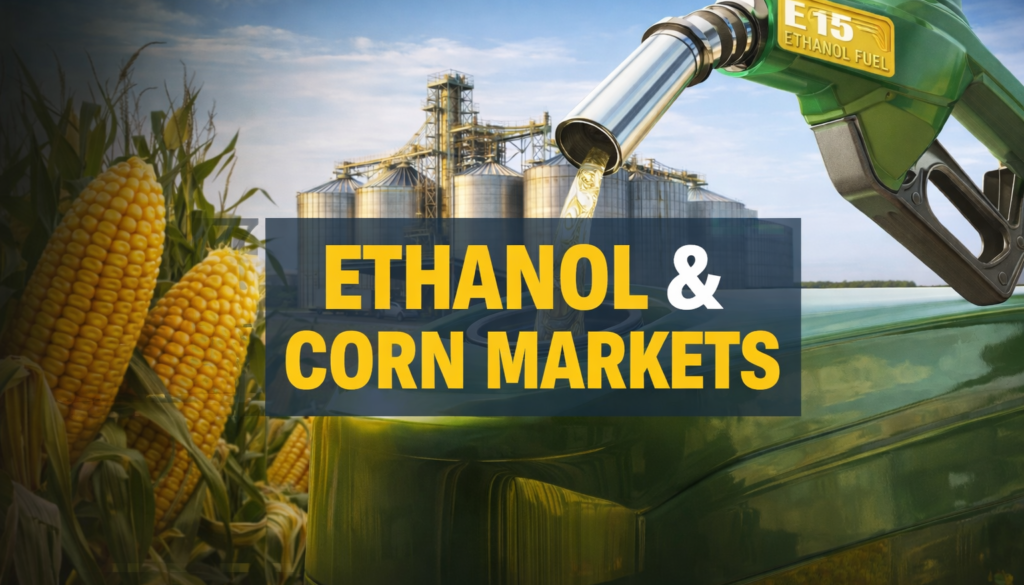
President Trump’s recent visit to Iowa reignited a long-running debate in agriculture and energy policy: year-round sales of E15 ethanol blends. While the headlines sound bullish for corn and biofuels, the real impact is more nuanced — and that distinction matters for producers, merchandisers, and operators across the grain industry.
In a recent episode of Grain Markets and Other Stuff, the ethanol story was unpacked in detail, separating political momentum from market reality. Below is a clear breakdown of what was said, what’s changed, and what hasn’t.
What Trump Said in Iowa About E15
Speaking at the Horizon Event Center in Clive, Iowa, President Trump said Congress is very close to approving nationwide, year-round E15 sales, adding that he would sign such a bill without delay if it reaches his desk.
These comments came after lawmakers failed to include E15 language in a recent government funding bill, opting instead to discuss alternative approaches such as task forces or councils. According to reporting by Reuters, that omission frustrated ethanol producers and corn groups who have pushed for permanent regulatory clarity rather than temporary fixes.
🔗 https://www.reuters.com/business/energy/us-congress-create-ethanol-task-force-after-e15-deal-falls-through-2026-01-22/
Shortly after Trump’s remarks, USDA Secretary Brooke Rollins released a statement reinforcing the administration’s support, emphasizing energy security, rural jobs, and expanded domestic biofuel use.
Why Year-Round E15 Matters — and Why It’s Not a Silver Bullet
E15 — gasoline blended with 15% ethanol — has long been limited during summer months due to Clean Air Act regulations. Removing those restrictions nationwide would give retailers the option to sell E15 year-round, not mandate its use.
That distinction is critical.
Industry groups often cite projections suggesting that nationwide E15 adoption could eventually increase corn demand by up to 2 billion bushels, but those gains would occur gradually over many years, not overnight.
The American Farm Bureau explains that while E15 can meaningfully expand ethanol demand, infrastructure investment, consumer adoption, and market pricing ultimately determine how much ethanol is actually consumed.
🔗 https://www.fb.org/market-intel/e15-boosting-corn-demand-and-lowering-gas-prices
As discussed in the video, year-round E15 is not a mandate. Retailers are not forced to sell it, and consumers are not forced to buy it. Market behavior — not policy headlines — will decide the outcome.
Ethanol Demand vs. Ethanol Exports
One under-discussed factor is ethanol exports.
In 2025, the U.S. produced roughly 16.1–16.3 billion gallons of ethanol, with about 13% exported. A key question raised in the analysis:
If domestic E15 demand rises, does that actually increase total ethanol production — or simply reduce exports?
That dynamic matters when evaluating whether year-round E15 truly tightens corn balance sheets or just reshuffles where ethanol is consumed.
As of now, corn markets appear to be signaling caution. Despite the political attention, corn futures remain range-bound, suggesting traders do not see immediate, material changes to supply-and-demand fundamentals.
Why Markets Haven’t Reacted (Yet)
If year-round E15 were expected to dramatically alter near-term corn usage, markets would likely reflect that optimism. So far, they haven’t.
As highlighted in the video:
- Corn prices have not broken out of recent ranges
- Ethanol demand growth remains incremental
- Any meaningful demand shift would take time to materialize
That doesn’t make E15 irrelevant — it simply means it’s structural, not explosive.
FarmProgress has repeatedly noted that while E15 expansion is directionally positive, its influence on prices depends on adoption speed and broader energy markets.
🔗 https://www.farmprogress.com/commentary/new-demand-on-the-corn-horizon-
The Broader Policy Context
Supporters argue that year-round E15 strengthens:
- Domestic energy security
- Rural employment
- Long-term corn demand
The National Corn Growers Association has emphasized that permanent E15 access would provide stability for ethanol investments and reduce reliance on temporary EPA waivers.
🔗 https://ncga.com/stay-informed/media/the-corn-economy/article/2025/10/the-case-for-e15-boosting-demand-for-american-corn
At the same time, analysts caution against overstating near-term impacts, particularly in a market already wrestling with acreage decisions, input costs, and global competition.
Bottom Line
Trump’s Iowa comments put year-round E15 back in the spotlight — and politically, momentum appears to be building. But from a market perspective, E15 is a long-game policy, not a short-term fix.
It’s a positive development for ethanol and corn over time. It’s just not a switch that instantly flips the balance sheets.
For now, markets are watching, not reacting — and that may be the most honest signal of all.
At Control Chief, we work alongside the grain industry at every point where product moves — from facilities and conveyors to rail operations and shiploading environments. Our focus is on the people responsible for moving grain safely and efficiently, especially where locomotive and industrial remote control play a role in daily operations. As grain markets, energy policy, and infrastructure continue to evolve, we pay close attention to how those changes affect real-world logistics on the ground, not just headlines.
Views: 33