Grain Shiploading: How It Works and Why Remote Controls Matter
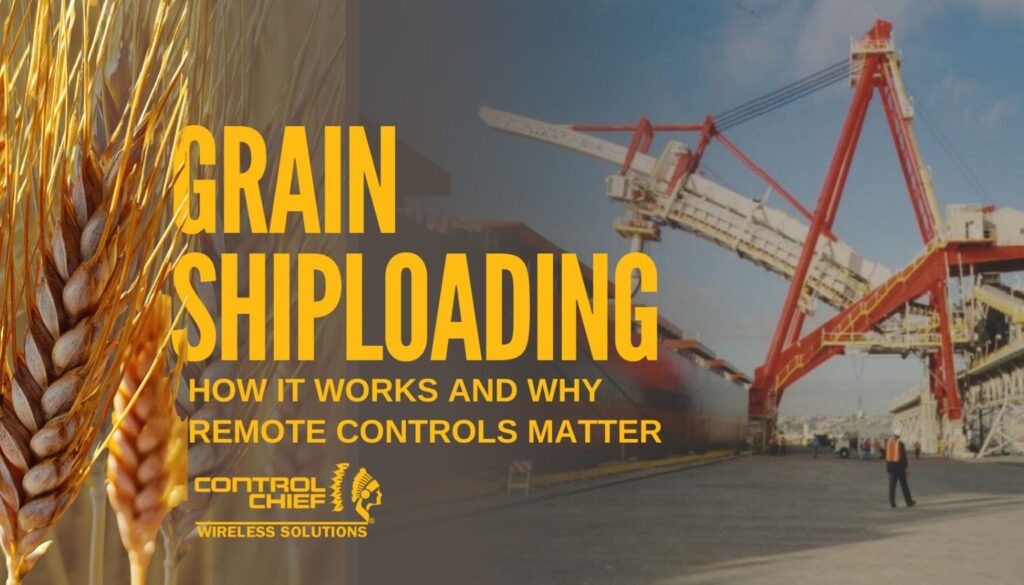
Moving grain from inland storage to ocean-going vessels is a vital link in the global agricultural supply chain. Whether it’s wheat, corn, soybeans, or barley, grain export terminals must transfer massive volumes of bulk grain from silos into bulk carriers quickly, efficiently, and safely.
At the core of this process are grain shiploaders — heavy machinery designed to gently lift and convey grain from conveyor systems into a ship’s hold. These machines can load thousands of tons per hour and often feature slewing booms, telescoping spouts, and integrated dust-control systems to minimize product loss and environmental impact. Grain shiploaders are engineered to handle the bulk material efficiently while protecting grain quality by reducing breakage and dust generation.
But even the most advanced loader needs equally capable controls to operate at peak performance. That’s where remote control systems come into play.
The Role of Remote Controls in Grain Shiploading
Traditional shiploader operation typically takes place from fixed control cabins or wired, hard-pendant stations. While functional, these setups can limit visibility and responsiveness — especially when precision and timing matter most. Modern terminals increasingly rely on industrial wireless remote controls to keep operations productive and safe.
What Control Chief Offers
Control Chief Corporation builds industrial wireless remote control solutions engineered for the demanding environment of shiploading — including high-capacity grain terminals. Their systems are custom configured to match the exact needs of your shiploader and terminal setup, with rugged construction and flexible I/O configurations that integrate with existing equipment.
Advantage Series Receivers
Control Chief’s Advantage Series remote control receivers are designed for industrial equipment such as shiploaders and material handling systems. Key features include:
- Modular digital and analog inputs and outputs
- Application-specific logic using “PLC-on-a-Chip” technology
- Compatibility with licensed and unlicensed RF bands
- Integrated diagnostics and safety monitoring
- Industrial enclosures built for harsh port environments
The Advantage Series receiver acts as the control backbone — translating operator commands into precise movement of boom controls, slewing functions, spout positioning, and conveyor operation.
Operator Control Units
Paired with Advantage Series receivers are rugged Operator Control Units, including the Crane Chief®. These handheld units give operators direct, responsive control of shiploader functions while allowing them to move freely along the dock.
By using an Operator Control Unit, operators can:
- Stand where they have the best visibility into the vessel hold
- Make fine adjustments during trimming and topping-off
- Avoid repeated climbs into fixed control cabs
- Reduce fatigue during long loading cycles
These Operator Control Units are designed for industrial environments where dust, vibration, moisture, and weather exposure are part of daily operation.
The Safety Triad: Built-In Protection at Every Level
Safety is engineered directly into Control Chief systems through its Safety Triad architecture.
The Safety Triad is made up of three coordinated subsystems that work together to ensure controlled, predictable operation:
Safety Subsystem
The Safety subsystem is the heart of the Safety Triad. A dedicated watchdog continuously monitors the Machine Control Unit (MCU), internal circuitry, and RF link status. Dual mainline relays are controlled by this watchdog, and multiple valid signals must be present before outputs are enabled—helping prevent unintended motion.
Radio Subsystem
The Radio subsystem manages two-way communication between the Operator Control Unit and the receiver using a robust 900 MHz frequency-hopping RF link. A valid RF connection is required before the system allows mainline outputs to energize.
Fieldbus Subsystem
The Fieldbus subsystem handles communication between the Advantage Series receiver and the shiploader’s control system. Commands are formatted to match the specific industrial protocol used by the equipment, allowing seamless integration with a wide range of shiploader control architectures.
Together, these three subsystems create layered monitoring of communication, logic, and control—helping protect both operators and equipment during grain shiploading operations.
Why This Matters for Grain Operations
Better Visibility and Precision
Operators can position themselves where they have the clearest view of the loading spout and vessel hold, improving placement accuracy and reducing spillage.
Improved Safety
Wireless control allows operators to maintain distance from moving structures, pinch points, and dust-heavy areas without sacrificing responsiveness.
Increased Efficiency and Throughput
Eliminating unnecessary movement between fixed control locations helps speed up transitions between holds and supports faster vessel turnaround times.
Custom Integration
Each Control Chief system is configured to the specific shiploader and terminal workflow—without unnecessary features or limitations.
A Practical Control Solution for Grain Export Terminals
Grain shiploading demands reliability, precision, and safety under constant pressure. Control Chief’s Advantage Series receivers, Crane Chief® Operator Control Units, and Safety Triad architecture provide a functional, industrial-grade solution designed for real-world terminal operations.
By giving operators better visibility, responsive control, and built-in safety monitoring, Control Chief helps grain terminals move product efficiently—one vessel, one hold, and one load at a time.
Headed to GEAPS Exchange 2026?
If you’re involved in grain handling, export operations, or terminal management, GEAPS Exchange is one of the most important events on the calendar. It’s where grain professionals gather to talk equipment, operations, safety, and what’s next for the industry.
To help you make the most of the show, we’ve put together The Ultimate Unofficial Guide to GEAPS Exchange 2026 in Kansas City—including what to expect, where to go, and how to plan your time if you’re attending.
👉 Read the guide here
Whether you’re walking the floor, meeting with vendors, or just trying to get more value out of the trip, the guide is a good place to start.
Views: 35